

When delving into the realm of precision engineering, Round Spring Steel Collets stand out as indispensable components. As a dedicated Round Spring Steel Collet supplier, I've witnessed firsthand the critical role these collets play in numerous industrial applications. One question that frequently arises in discussions with our clients is, "What is the fatigue life of a round spring steel collet?"
Understanding Round Spring Steel Collets
Before we explore the fatigue life, let's first understand what Round Spring Steel Collets are. Round Spring Steel Collets are high - precision workholding devices commonly used in CNC machines, lathes, and other machining equipment. They are designed to securely hold round workpieces, enabling precise machining operations. The collets are made from high - quality spring steel, which gives them the necessary flexibility and strength. This steel is carefully heat - treated to achieve the optimal balance between hardness and elasticity, ensuring that the collet can grip the workpiece tightly without permanently deforming.
Our Round Spring Steel Collet is fabricated with extreme precision. Each collet is crafted to have a specific inner diameter, which corresponds to the size of the workpiece it can hold. The outer surface of the collet is designed to fit perfectly into the collet chuck or spindle of the machine, ensuring that there is no misalignment during operation.
The Concept of Fatigue Life
Fatigue life refers to the number of stress cycles that a component can withstand before it fails due to fatigue. In the context of round spring steel collets, fatigue failure occurs when the collet can no longer hold the workpiece securely or when cracks start to appear on the surface of the collet.
When a round spring steel collet is in use, it is subjected to cyclic loading. Every time a workpiece is clamped and unclamped, the collet experiences a change in stress. During the clamping process, the collet is deformed as it contracts around the workpiece, and during the unclamping process, it returns to its original shape. This repeated deformation and relaxation create cyclic stress on the collet.
The fatigue life of a round spring steel collet is affected by several factors, including material properties, design, operating conditions, and manufacturing quality.
Material Properties
The choice of spring steel is crucial in determining the fatigue life of a round spring steel collet. High - quality spring steels, such as alloy steels with a proper combination of carbon, chromium, vanadium, and other elements, have better fatigue resistance. These steels are able to withstand a large number of stress cycles without significant degradation.
Our collets are made from advanced alloy spring steels that have been specifically selected for their excellent fatigue properties. The heat treatment process that these steels undergo also plays a vital role. A well - executed heat treatment can improve the hardness, strength, and toughness of the steel, enhancing its fatigue resistance.
Design
The design of the round spring steel collet can significantly impact its fatigue life. A well - designed collet evenly distributes the clamping force around the workpiece, reducing the concentration of stress in any particular area. This helps to prevent premature fatigue failure.

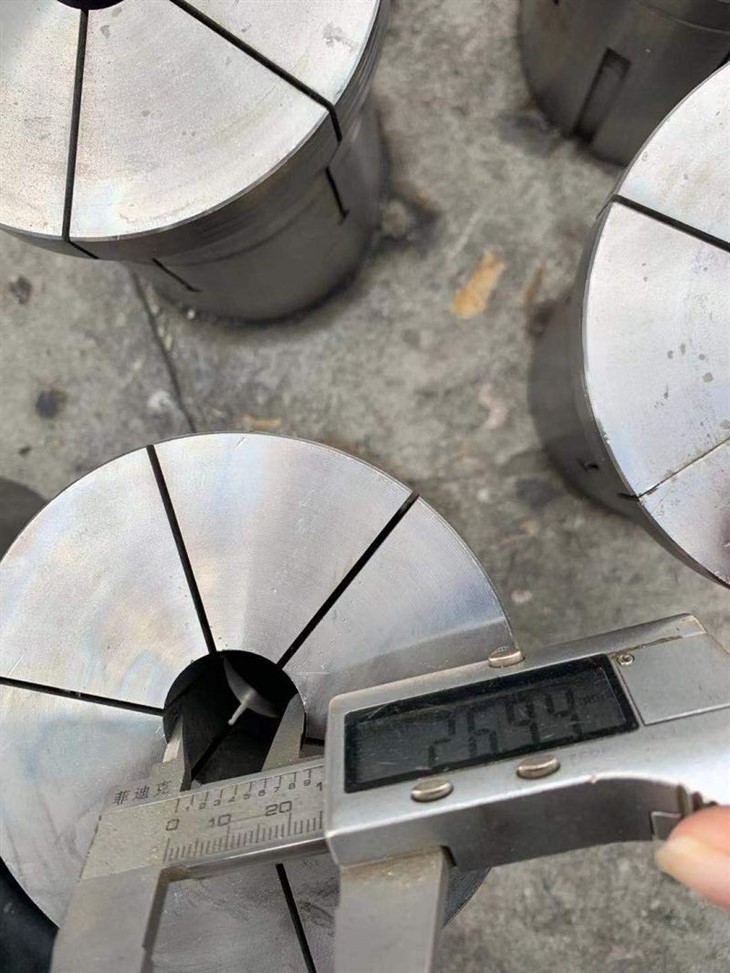
For example, the number of splits in a round spring steel collet affects its stress distribution. A collet with more splits can distribute the clamping force more evenly, reducing the stress concentration at each split. Additionally, the shape and size of the chamfers at the ends of the collet can also influence stress distribution. Properly designed chamfers can reduce stress concentrations at the edges of the collet, thereby extending its fatigue life.
Operating Conditions
Operating conditions have a profound effect on the fatigue life of a round spring steel collet. Factors such as the frequency of clamping and unclamping, the magnitude of the clamping force, and the temperature of the operating environment all play a role.
If a collet is subjected to a high frequency of clamping and unclamping operations, it will experience more stress cycles in a given period of time, which can significantly reduce its fatigue life. Similarly, if the clamping force is too high, it can cause excessive stress on the collet, leading to premature fatigue failure.
The temperature of the operating environment is also important. High temperatures can reduce the strength and hardness of the spring steel, making the collet more susceptible to fatigue. In contrast, extremely low temperatures can make the steel more brittle, increasing the risk of cracking.
Manufacturing Quality
The manufacturing process of a round spring steel collet has a direct impact on its quality and fatigue life. Precision machining is essential to ensure that the collet has the correct dimensions and surface finish. Any manufacturing defects, such as machining marks, scratches, or uneven surfaces, can act as stress concentrators, reducing the fatigue life of the collet.
Our manufacturing process incorporates strict quality control measures. We use state - of - the - art machining equipment to produce collets with high precision. Each collet is carefully inspected for dimensional accuracy and surface quality before it leaves our factory.
Estimating the Fatigue Life of Round Spring Steel Collets
Estimating the fatigue life of round spring steel collets can be challenging due to the complex interaction of the factors mentioned above. However, we can use some general guidelines and testing methods to provide an approximate estimate.
Fatigue Testing
One of the most reliable ways to determine the fatigue life of a collet is through fatigue testing. In a fatigue test, a collet is subjected to a controlled cyclic loading in a testing machine. The number of cycles it can withstand before failure is recorded. By conducting multiple tests under different loading conditions, we can establish a relationship between stress amplitude, frequency, and fatigue life.
However, fatigue testing is time - consuming and expensive. As a supplier, we have conducted extensive in - house fatigue testing on our Round Spring Steel Collet to gather data on its fatigue performance. We use this data to provide our clients with an estimated fatigue life based on their specific operating conditions.
Theoretical Calculation
Theoretical calculations can also be used to estimate the fatigue life of a round spring steel collet. However, these calculations often make simplifying assumptions, so the results are only approximate.
One common approach is to use the stress - life method. This method involves calculating the stress amplitude in the collet under the given operating conditions and then using an S - N curve (stress - number of cycles curve) for the material to determine the corresponding fatigue life. The S - N curve is a plot of the stress amplitude versus the number of cycles to failure for a given material.
Comparison with Other Collet Types
In addition to round spring steel collets, there are other types of spring steel collets, such as Octagonal Spring Steel Collet and Hex Spring Steel Collet. Each type of collet has its own advantages and characteristics in terms of fatigue life.
Octagonal and hex spring steel collets are often used for non - round workpieces. Their design allows them to grip polygonal workpieces securely. However, in terms of fatigue life, round spring steel collets generally have an advantage. The round shape of the collet allows for a more uniform distribution of stress during the clamping process, reducing stress concentrations and extending the fatigue life.
Maximizing the Fatigue Life of Round Spring Steel Collets
As a supplier, we want our clients to get the most out of our round spring steel collets. Here are some tips on how to maximize the fatigue life of the collets:
- Proper Usage: Use the collet within its specified loading limits. Avoid over - clamping the workpiece, as this can cause excessive stress on the collet.
- Regular Maintenance: Keep the collet clean and lubricated. Dirt and debris can cause uneven wear and stress concentrations, reducing the fatigue life of the collet.
- Correct Installation: Ensure that the collet is properly installed in the machine. A misaligned collet can cause uneven loading and premature fatigue failure.
Contact Us for Purchase and Consultation
If you are in the market for high - quality round spring steel collets, look no further. We are committed to providing our clients with top - notch products that offer long fatigue life and reliable performance.
Whether you have questions about the fatigue life of our collets, need assistance in selecting the right collet for your application, or are ready to place an order, we are here to help. Contact us today to start a discussion about your requirements. We can provide you with detailed product information, customization options, and competitive pricing. Let us be your trusted partner in precision workholding solutions.
References
- Shigley, J. E., & Mischke, C. R. (2001). Mechanical engineering design. McGraw - Hill.
- Dowling, N. E. (2012). Mechanical behavior of materials: Engineering methods for deformation, fracture, and fatigue. Pearson.
- Fatigue of materials. Suresh, S. (1998). Cambridge University Press.